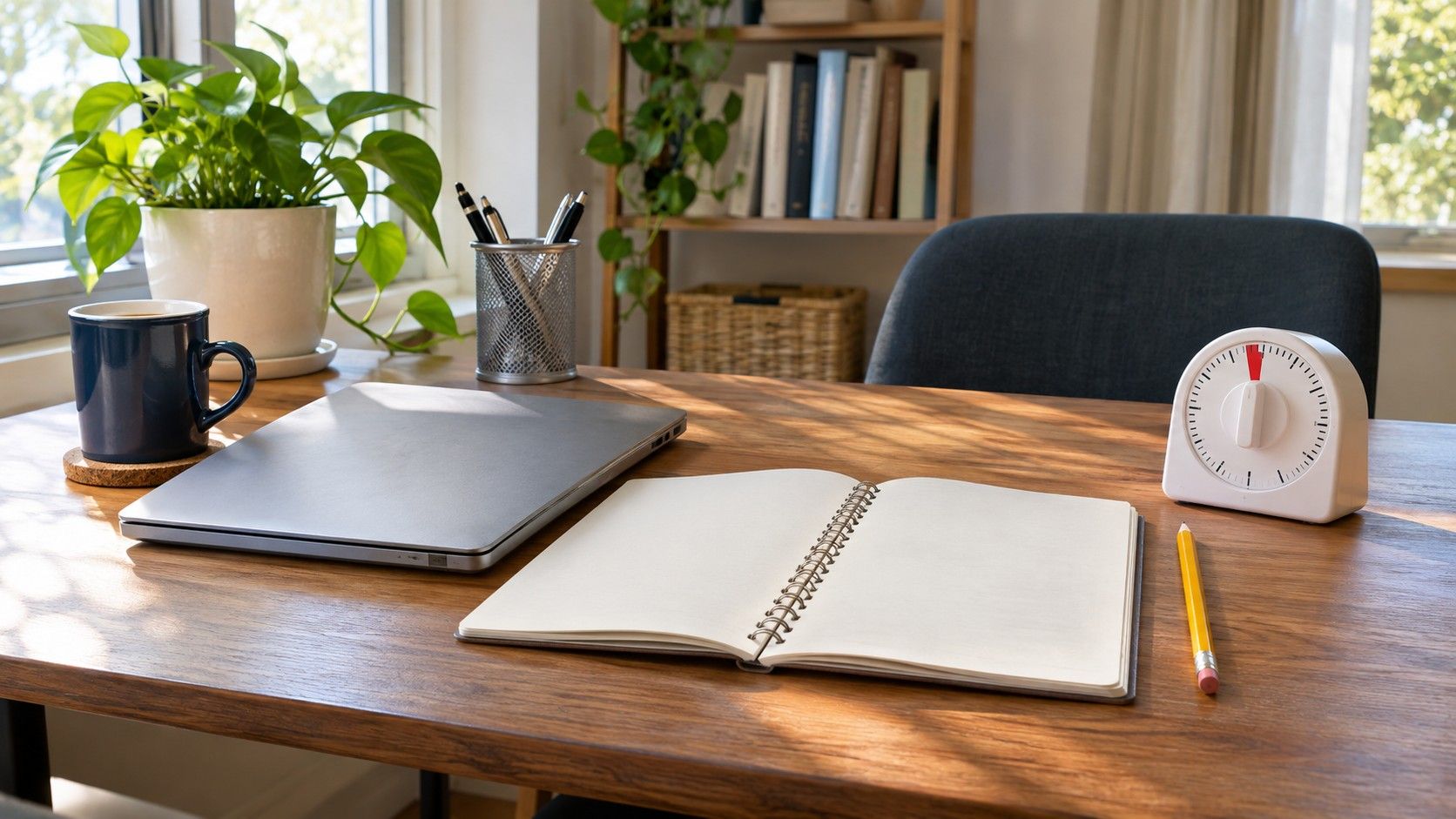
A home practice session is useful when it has a clear start, a defined set of tasks, and a review that explains the result. Without those boundaries, interruptions and extra time can make a score impossible to interpret. Build a manageable mixed session around relevant reading, writing, and judgment skills while keeping it distinct from the official assessment named in your application.
Choose tasks before starting
Pick fresh material and decide the order before you begin. A short reading block, a factual report from an original incident, and several written judgment scenarios can form a practical study session. The mix and duration are your learning design, not a published police exam specification. Match the skills to the exam named in the vacancy instead of assuming every police test uses the same sections.
Write the limit for each block and what you will count. For reading, keep attempted items and correct items separate. For writing, preserve the notes and draft. For judgment, mark uncertain answers before checking explanations. These records will tell you whether a changed score reflects better reasoning, a different pace, or a remembered question.
Avoid adding tasks halfway through because the early work feels easy. That turns a planned comparison into an improvised endurance exercise. You can add another learning task after the session, but label it separately. A stable small session is more useful for tracking a specific habit than an ambitious one whose rules change every time.
Arrange a quiet test space
Clear the desk of answer keys, open reference tabs, and notifications. Prepare the materials allowed by the home exercise and check that any legitimate video or audio resource works before starting. Technical checks belong before the timed block; a failed speaker should not be misclassified as a listening or observation problem.
Tell other people when you expect to finish, if that will reduce interruptions. Choose a chair and screen arrangement you can use comfortably for the session. Do not treat this as evidence that you have recreated a testing center or remote proctoring setup. Your actual administration may have specific equipment, identity, room, and material rules that only the current official directions can establish.
If an interruption occurs, record it rather than pretending the attempt was clean. Decide in advance whether an unavoidable interruption ends the measurement or simply creates an interrupted attempt label. You can still learn from the work, but compare it cautiously with a quiet session. A clear record is better than quietly adding back minutes until the score looks normal.
Run reading and writing blocks
During reading, follow one consistent method: understand the passage, identify the request, compare choices against the text, and commit. Do not open explanations after each question. Mark uncertainty and move according to the exercise directions. When the planned limit ends, separate on-time answers from work completed afterward for learning.
For the writing block, use an original short incident you have not already rehearsed. Capture the people, actions, objects, sequence, and attributed statements. Draft the central event before polishing language. Leave enough of your chosen study limit for a factual check: every claim should come from the incident or notes, and every central action should be understandable to someone who did not see it.
In a written judgment block, read the complete responses. Identify what the character knows and controls. A friendly answer may still promise an unsupported outcome; a forceful answer may address an imagined problem. Written scenarios help train analysis but cannot fully reproduce the demands of moving images. Use the format honestly rather than calling it an exact substitute.
Review after the complete session
Finish the planned blocks before opening the answer explanations. Then review errors by cause. A missed condition, an unknown word, an unsupported inference, and an unfinished question are different problems. For writing, check factual reliability before spelling and style. For judgment, explain why the strongest alternative is weaker, not merely why the chosen answer sounds reasonable.
Compare the first and final parts of the session. Did later reading become less accurate because you stopped checking conditions? Did writing take longer than planned because your notes were hard to decode? Did you begin choosing answers from their tone instead of their action? These observations can reveal a transition or attention problem that isolated drills miss.
Keep a compact summary rather than a page of vague self-criticism. For example: reading, two errors from only and except; report, one unclear actor; judgment, two promises beyond the role. Add one repair for the next session. A useful review produces an action small enough that you can actually carry it out.
Repeat with a useful change
Choose fresh material for the next measured session and change only what you intend to test. If the target is conditional reading, keep a similar block length while deliberately checking limiting words. If the target is report clarity, use stable role labels at every change of actor. Too many simultaneous changes make it hard to tell which adjustment helped.
Keep accuracy, completion, and confidence separate. A higher percentage on fewer attempted items may reflect more careful work but still leave pacing unresolved. A faster attempt with many guesses is not necessarily an improvement. Different question difficulty also limits direct comparisons; record the resource and whether the set was fresh or reused.
Once a behavior holds in several fresh tasks, fold it into your normal method and select the next weakness. Keep occasional slower sessions for analysis. Constant time pressure can encourage you to repeat an error quickly without understanding it. The purpose of the home session is to make preparation observable, so that the following hour of study has a concrete job.